It has been my pleasure and honor to work with various aspects of the National Pork Board (NPB) in recent years. Since the Board is at one level a grassroots organization and a Public Private partnership at another, I would like to offer some observations. Here are 10 things I have observed about this organization.
1) The National Pork Board is a Public/Private partnership that is funded by mandatory checkoff dollars from anyone that sells a market hog.
Public in that it is overseen closely by USDA in Washington DC. The secretary of Ag holds final appointment powers over the seats on the board. USDA, through the Ag Marketing Service, watches the $$$ closely. So closely in fact that if my wife travels with me on a Pork Board activity, we must keep separate receipts. An unexplained can of pop with my snack at the airport will get questioned. Interestingly, a $40 dinner for me will sale right through.
Private in that the money that funds the organization comes directly and exclusively from private producer pocket books. Great effort is expended for all private producers to have a voice in how these $$$ are spent. I have found it quite possible for a single producer's voice to influence many actions of the Pork Board.
2) Money talks. It should surprise no one, that since funds are collected based on the sale of market animals, those who sell large numbers of animals contribute larger sums of $$$ than those who sell lesser numbers. This at one level is fair. It should not surprise you then to discover that those people/organizations that are contributing large numbers of $$$ to fund the organization seem to have a way of getting things done that are agreeable to their viewpoint. This is not to imply anything untoward of anyone. It is to recognize the reality that $$$ talks and wise management has a way of listening.
3) Generous and caring people. I have met many very fine caring people in my activities with the National Pork Board. I have found that the people involved have a natural bent toward generously helping others, even at great personal, mental, and financial expense. When I am in the company of fellow volunteers I feel a sense of connectedness, importance, and pride. It is an energizing thing.
4) Climate change is institutionalized. I have heard researchers say that scientist are not being promoted in academia unless their research has moved the needle on Climate Change. The big money is going to climate research. Academia has gotten the message loud and clear. The administration (written during the Obama administration) (USDA) is focused on climate change, controls board appointments at the National Pork Board, is the regulator that the National Pork Board must work with, so climate change is the order of the day.
"People pigs and planet", is the tag line that is published on every piece of paper coming from the National Pork Board. Which sounds very much like the tag line for the environmental accounting system know as "the Triple Bottom Line", that system is often called" Profit, People and Planet". read more here "People, Planet, Profit" appears way down This accounting leads directly to discussions of sustainability and continuous improvement. Two concepts that are making obvious appearances in the National Pork Boards activities.
Government control of an industry is not far behind, which, of course, equals the lose of private property rights, which means a lose of individual freedom. Gone are discussions about the freedom to operate that I used to hear at National Pork Board events. Secretary Vilsack states openly, "....we delegate the responsibility of raising food to farmers....". Where do I go to get my certificate that says the right to farm has been delegated to me?
5) There is a natural tendency toward organizations getting bigger. More regulations are not as harmful to the big operation as they are to the smaller one, so the big operation can use regulations to put pressure on the smaller one. The Common Swine Industry Audit (CSIA) does exactly this. Whether it is intentional or not you can decide. The packers, who incidentally own a lot of hogs and therefore contribute a lot to the checkoff appear to me to be less concerned about the audit than the independent producer. This stands to reason, since the CSIA is funded and administered outside the National Pork Board's budget and control. The packers are the primary funders of the audits.
6) There are "elites" that have larger voices than others. They don't even have to own pigs or eat meat to influence NPB actions. Temple Grandin has never attended a meeting of the animal welfare committee in the time I have been there or been on a conference call that I have attended, but she can/has changed the course of the committee's decisions simply by dropping an email to the chairman. Is this wrong? I don't know. But it certainly puts her in a class of people where there are but a few members, an "elite".
Food industry executives and financiers are another group that has similar power. I witnessed this at the Sustainable Ag Summit, in a break out session on investing. It was clear the investment fund managers on the stage had the attention of the executives from some of the world's largest food companies and that policies were going to be changed in accordance with these views. No where in the discussion was the farmer or National Pork Board for that matter mentioned. Again, money talks.
7) Over in the beef side of life, cattlemen resisted the expansion of their checkoff. Ag Secretary Vilsack attempted to start a new checkoff which failed. The administration (USDA) then cut beef from dietary guidelines. You connect the dots.
The pork industry hired a CEO from the packing industry who made the rounds of state organizations talking about People, Pigs, and Planet but saying the industry could define "Sustainability" however it wanted (see #4 above). This CEO lasted less than a year. read of the reality here "...Sustainable development was defined by the Brundtland Commission of the United Nations in 1987." A new CEO is hired who introduces himself as, "...working for those who pay checkoff...". See point #2. And " .....I am glad Pork doesn't have an RCALF...". If you see RCALF as a group of cattlemen adamantly defending individual property rights and personal freedom, I fear challenges ahead. (see point 4 and 9).
9) The pork industry is on a path of consolidation, the packers (the big $$$ in #1) seem to have a lot of control. They seem interested in margin on volume. This makes it easy to understand the industry's support for multinational trade deals like the Trans Pacific Partnership (TPP). The trade deals would bring in more volume, therefore more margin. Consequently, all I have heard as a producer is, "It is great!", without any discussion of the impacts on freedom and US sovereignty. The added rules put pressure on the independent producer in the form of added costs that naturally drives those producers to consider contracting with the packers (see #5). I share more thoughts in this blog
10) I am not trained in corporate communication/politics/coalition building etc. I simply have my own eyes, ears, ideas and conscience (individualism) to fall back on and hope for support. Many things seem to be discussed outside of the meetings I attend since many of the people know each other on multiple levels from multiple professional situations. I have never felt directly excluded from a conversation in particular but many times the conversation goes right past me or over my head. I simply don't have the connections to piece the conversation together. This leaves me feeling like a lone small voice many times. But from time to time my voice makes a difference (see #1). I am glad I can have that kind of impact for my fellow producers.
This blog attempts to cause people to begin thinking more deeply about the philosophy and ethics of food.
Friday, February 24, 2017
Wednesday, January 4, 2017
Sustainability, Continuous Improvement, and Cllimate Change
Have you ever pondered the definition of the terms "sustainability" or more recently, "continuous improvement"? Did you ever ask a farmer for the definition of these words?
I attended a conference on behalf of the National Pork Board's animal welfare committee in November of 2016 entitled "2016 Sustainable Agriculture Summit" in Atlanta Georgia.
Somewhere along the way the thought occurred to me, "Both Sustainability and Continuous Improvement have at their core definition the necessity of measurement".
If you are an astronaut and are planning a trip in space one of the first questions you will have is, "Is it sustainable?" "Can I live through it?" "Is there enough air on board?" All these questions require measurement to answer. How long (measurement) will the trip be? How much (measurement) air does a person require for that time? And what margin (measurement) of error should be considered adequate.
Continuous Improvement is similar in nature. How do I know if I am improving? I will need to measure what I am doing now. That measurement will become a benchmark from which all others are measured to ascertain improvement.
Measurement is so central to these two concepts that it is practically a synonym. If the word "sustainability" is replaced with "measurement" not much is lost in the meaning of the sentence. For example, one of the sessions at the Sustainable Agriculture Summit was titled "Implementing a Sustainable Framework in the Pork Supply Chain". This can also be written "Implementing a Measurable Framework in the Pork Supply Chain". Or another session was described as "Engaging farmers in on-farm conservation and broadersustainability measurability initiatives....
Continuous Improvement kind of tags along on this same definitional train. It becomes the first outcome of measurement. To improve you need two measurements to find improvement. A beginning point and then a point after taking an action aimed at improving.
These two measurement activities are extremely common and completely human. I check my weight. I check my blood pressure. I measure rate of gain in pigs. I measure days on feed. And on and on through life. All with the idea of improving or doing better next time. Measurement and continuous improvement are not a new discovery or idea.
One of the first rules of management that I learned so very long ago says, "If you can't measure it, you can't manage it." I am not concerned with the word "measurement" in this management truism. I am concerned with who the "you" is that is doing the management. If the "you" is "me", an independent producer and free citizen, then the management does not seem so scary. If the "you" becomes a government board or an industry auditor, let alone a global agency, with the power to impose standards on management and demand proof of compliance, I, the farmer, have lost the ability to manage my own farm. I have fundamentally lost freedom.
The concepts of measurement, continuous improvement, and management become drivers in the Climate Change dogmas. Specifically, the dogma that Climate Change is caused by man's activities and therefore man's activities need to be managed by..... who?. The typical answer right now is that the management must be done by the government and more specifically a global government.
I am hearing an enormous amount of discussion in farming about measuring new things. "Precision Farming", "Carbon Sequestration", "Cover Crops", "Methane Digesters", to name a few, that require the measurement of parameters that are new to the agricultural discussion. In general anything attached to the Carbon Footprint discussion takes measurement and recordkeeping. Keep in mind that every measurement creates multiple data points that need to be recorded, stored, and analyzed. So there is a whole different discussion to be had about data, its use, security, and ownership. Not that measuring is bad, as I have said. It is "who" is managing with that information that concerns me.
A couple other thoughts and I will stop.
All this data collection, reporting, analysis, and management takes time, money, and talent. So a natural advantage is created for the larger operator who can afford it. Read this as consolidation or vertical integration. I have discussed thoughts on this topic at On Mergers Foreign Ownership and Consolidation
The animal welfare discussion would be enormously different if there was a way to measure pain in an animal or human for that matter. Without measurement, management is guess work and writing meaningful regulations is impossible.
So I hope I have helped to point out that the timeless little action of "measuring" has found deep roots in the Climate Change discussion. How that proceeds has large implications for the future freedoms of agricultural producers.
You may learn more about my involvement with the National Pork Board at my blog entitled A Seat on the National Pork Board
I attended a conference on behalf of the National Pork Board's animal welfare committee in November of 2016 entitled "2016 Sustainable Agriculture Summit" in Atlanta Georgia.
Somewhere along the way the thought occurred to me, "Both Sustainability and Continuous Improvement have at their core definition the necessity of measurement".
If you are an astronaut and are planning a trip in space one of the first questions you will have is, "Is it sustainable?" "Can I live through it?" "Is there enough air on board?" All these questions require measurement to answer. How long (measurement) will the trip be? How much (measurement) air does a person require for that time? And what margin (measurement) of error should be considered adequate.
Continuous Improvement is similar in nature. How do I know if I am improving? I will need to measure what I am doing now. That measurement will become a benchmark from which all others are measured to ascertain improvement.
Measurement is so central to these two concepts that it is practically a synonym. If the word "sustainability" is replaced with "measurement" not much is lost in the meaning of the sentence. For example, one of the sessions at the Sustainable Agriculture Summit was titled "Implementing a Sustainable Framework in the Pork Supply Chain". This can also be written "Implementing a Measurable Framework in the Pork Supply Chain". Or another session was described as "Engaging farmers in on-farm conservation and broader
Continuous Improvement kind of tags along on this same definitional train. It becomes the first outcome of measurement. To improve you need two measurements to find improvement. A beginning point and then a point after taking an action aimed at improving.
These two measurement activities are extremely common and completely human. I check my weight. I check my blood pressure. I measure rate of gain in pigs. I measure days on feed. And on and on through life. All with the idea of improving or doing better next time. Measurement and continuous improvement are not a new discovery or idea.
One of the first rules of management that I learned so very long ago says, "If you can't measure it, you can't manage it." I am not concerned with the word "measurement" in this management truism. I am concerned with who the "you" is that is doing the management. If the "you" is "me", an independent producer and free citizen, then the management does not seem so scary. If the "you" becomes a government board or an industry auditor, let alone a global agency, with the power to impose standards on management and demand proof of compliance, I, the farmer, have lost the ability to manage my own farm. I have fundamentally lost freedom.
The concepts of measurement, continuous improvement, and management become drivers in the Climate Change dogmas. Specifically, the dogma that Climate Change is caused by man's activities and therefore man's activities need to be managed by..... who?. The typical answer right now is that the management must be done by the government and more specifically a global government.
I am hearing an enormous amount of discussion in farming about measuring new things. "Precision Farming", "Carbon Sequestration", "Cover Crops", "Methane Digesters", to name a few, that require the measurement of parameters that are new to the agricultural discussion. In general anything attached to the Carbon Footprint discussion takes measurement and recordkeeping. Keep in mind that every measurement creates multiple data points that need to be recorded, stored, and analyzed. So there is a whole different discussion to be had about data, its use, security, and ownership. Not that measuring is bad, as I have said. It is "who" is managing with that information that concerns me.
A couple other thoughts and I will stop.
All this data collection, reporting, analysis, and management takes time, money, and talent. So a natural advantage is created for the larger operator who can afford it. Read this as consolidation or vertical integration. I have discussed thoughts on this topic at On Mergers Foreign Ownership and Consolidation
The animal welfare discussion would be enormously different if there was a way to measure pain in an animal or human for that matter. Without measurement, management is guess work and writing meaningful regulations is impossible.
So I hope I have helped to point out that the timeless little action of "measuring" has found deep roots in the Climate Change discussion. How that proceeds has large implications for the future freedoms of agricultural producers.
You may learn more about my involvement with the National Pork Board at my blog entitled A Seat on the National Pork Board
Thursday, December 8, 2016
A Seat on the National Pork Board
The application arrived quietly while I was away. It just slid, dropped, popped, or materialized (whatever an e-mail does when it arrives) in my "inbox" while I was out. It was not unexpected but still created a jarring sensation in my spirit when I saw it. Funny how small questions and comments grow into larger adventures while you are not paying much attention.
The application is a next step toward an appointment to the 15 member National Pork Board. It is a written application in an electronic sort of way. Fill it out on line. Send it back sort of thing. It is the first concrete step I will have taken to express my interest in an appointment. I think that is what jarred me. Up to now, I have just been asking questions and considering the possibility. Now it is here in my hand. What adventure lies ahead?
Early in my relationship with my wife some 30+ years ago we both remember me saying, "You know, if you marry me, you never know where you are going to end up!" I know now that it was a universally true statement. (Whether she married me or not neither of us, no one for that matter, knows where they will end up.) It was a statement that made our future sound exciting, so we liked it. We remember those words and laugh because our life together has been one adventure after another. We both sense that applying for an appointment to the Pork Board is the start of yet another adventure.
Let me bring you up to speed on just what this is all about.
The National Pork Board is a 15 member board of pork producers that are appointed by the Secretary of Ag to oversee the dollars collected through a mandatory check off. Anyone that sells a pig in the USA contributes financially to the Pork CheckOff. Since contributing to the check off is mandatory, the actions and programs of the board are limited by law, the Pork Act, to things that support all producers. Specifically, actions are limited to education, research, and market development. The board is not allowed to engage in political promotions in support of a candidate/party. The dollars are overseen by the Secretary of Ag through the USDA to ensure compliance with the law.
I have served as a director of the state version of this organization, Ohio Pork Producers Council, and am currently serving on the Animal Welfare Committee of the National Pork Board.
The process of being appointed to the board is not a short or simple one.
Step one is the application I spoke about at the beginning of this blog. This application finds its way to the 7 member nominating committee for review and scoring.
Step two is an in person interview with the nominating committee. This interview will be added to the candidate scoring. The interview includes a video session, photography, and the creation of an individual biography, that will supplement the nominating committee's work by allowing people to put a face and a voice with an application. These will be used in materials distributed to the state delegates at the Pork Forum. Here is a link to the 2017 candidates (click here to see 2017 candidates)
The next step, step three, is caucusing among the various state delegate bodies at the annual meeting of the National Pork Board known as Pork Forum. The challenge for a candidate is to get enough support (votes) from the various state delegates to be one of the top 8 vote getters. Votes are allocated according to the dollars of checkoff collected from various states. Large pork producing states have greater voting power than smaller ones since they contributed more dollars to the Checkoff. There is also a rule that says 12 states must be represented on the board. This is where the scoring done by the nominating committee can be important since state delegates rely on it to inform themselves of a candidate's suitability and qualifications for the board. The higher a person is voted in the ranking, the better, since the Secretary of Ag will pick 5 from this list of 8 to be appointed to seats on the National Pork Board. Traditionally, the top 5 would be picked but the Secretary has been known to do otherwise.
Step four is the waiting game after the Pork Forum vote. Waiting to see which of the 8 the Secretary of Ag chooses to appoint. I imagine this wait can be a month or two. Here is a link to another blog I wrote years ago describing my experience as a delegate involved in the election process. "Pig Farmers Vote for National Pork Board"
Two questions immediately come up, "Why do you want to be appointed?" and "What qualifications do you have for such an appointment?"
I need to reach back into my personal history to answer both these questions at the same time.
Back in the 1980's I was a student at Iowa State University studying Agricultural Business when I came through a history class that focused on American Agriculture. I remember reading about the efforts of farmers to band together for the common good. It was likely a discussion of the establishment of the local coop as a functioning legal entity that made an impression on me, more than the creation of commodity boards. From that class I realize that joint efforts for the common good can supplement the raw individual strength of the farmer and help sustain a stronger community.
It was during college that I was first elected to a leadership board by my peers. The organization was Inter Varsity Christian Fellowship and it's board was made up entirely of students overseen by an adviser, not unlike NPB in that sense. My major contribution was to transition meeting times from week nights to Friday night. I realized that the audience we were trying to attract to our meetings was generally available on a Friday night. Our members were less inclined to head to the bars and parties on Friday evening than the average student. Attendance dramatically increased when the switch was made. Last I heard the meetings are still on Friday night. An added benefit was the availability of speakers and meeting rooms.
After college, my first position was to manage the livestock operation and 2 employees of our family farm partnership in Ohio, Avalon Farms. My father had died during my college experience. My elder brother, Richard, managed the financial side of the operation.
During this period of my life I learned to work with and lead people senior to me. The two employees I was managing had been significant in my youth as they worked for my father. The challenge I faced as a college graduate, was gaining/keeping their respect of me as a leader when they certainly had superior knowledge and experience at the work we faced on the farm. You learn to swallow your pride, ask questions rather than give commands, negotiate, preposition ideas, man up, and from time to time lead without seeing the way very far in front of you, when faced with this challenge. I owe a huge debt to the training and tolerance I received at the hands of those two men.
During this time I was involved in bringing legal order to a discipleship ministry known as The Salt House near Wittenberg University, a local liberal arts college. The ministry had grown organically around several college students (affecting 50? students on a campus of 1000?) but was faced with a leadership vacuum upon their graduation. I was tasked with setting in place the legal, financial, and leadership structures to insure the ministry's survival. I oversaw the drafting of articles of incorporation, hiring of the first employee, fund raising efforts, and recruiting board members. The ministry lasted for another 10? years under these constructs.
I was accompanying a group of 15? students from this ministry, The Salt House, as an adult chaperone on a mission trip in Honduras when he said/she said accusations of impropriety between our host and a student flared up. Things went from amiable to untenable over night. It fell to my leadership to extricate everyone from that country ASAP. I got criticized. I got praised. I learned the valuable leadership lesson of doing the only reasonable thing possible and letting the chips fall where they may. I may be known as the "mission team leader from Hell" in some circles.
The family business partnership came to an end around 1997, signaling the start of my independent business career. I had 1000acres of cropland, cash, and 100 sows outside on 10 acres of beautiful black soil. I calculated that if I had those sows inside and was a good manager of pigs I could out perform my neighbor and have an edge in the pork industry. By contrast, if I was the best manager of crops in the county and it did not rain, I would have no edge. So I began expanding and moving the sows inside until I had about 600 sows. I sold weaner pigs to neighbors and others on contract. Then came $8 fat hogs and then $8 corn. Somehow I have grown through it all to 25000 wean to finish pigs annually plus the farm land. Working hard and plodding forward were the lesson of these challenges. That and a first hand understanding of the concept of "working capital" and "mortgage debt".
Some time fairly early in this independence I saw the fights with HSUS coming and wanted to be involved. Consequently, when offered, I ran for and won a seat on the Ohio Pork Producers Board of Directors. This was my first experience on a board of this magnitude and with this structure. It was a great learning experience.
(photo credit: Pork.org)
The most lasting and impactful lesson was the day the executive leadership organized a conference call and announced to the board that in a few hours they would be announcing an agreement (aka the Ohio Agreement) with HSUS on gestation stalls. It is no secret that I was upset at not being consulted as a director. I felt my own executive team did not trust me as a director with the confidential negotiation. The very negotiation that was the reason I had joined the board.
That one hurt!
Another experience came as a member of the committee tasked with writing the pork related sections of the Ohio Livestock Care Standards. This gave me a seat to see the inside workings of how a law gets implemented. I learned I don't have the skill set to be a strong leader in this area, since I am lacking the memory of minutia, legal background, and organizational knowledge needed. But I can summarize and evaluate presentations fairly quickly and with confidence. I can see the various manuvers the players are making and how that will roll down through the years. To that degree I enjoyed the experience.
(photo credit: OFBF.org)
It was during this time that I testified several times as an individual to the Ohio Livestock Care Standards Board in defense of the industry. I intentionally spoke immediately following Wayne Pacelle, taking the microphone while it was still hot from his hand and speaking on behalf of the industry and farmers in general. That was the day HSUS had bussed in several loads of activist and there were few farmers in the room. You learn that farmers like to say, "I would like to tell him/her (fill in anyone they vehemently disagree with) this or that!)" but when faced with an opportunity, they don't show up.
I remember telling my kids, "I may not win the argument, but it won't be because I did not speak." I learned from that experience that I have the metal to stand in front of a hostile audience and make a coherent presentation.
I have attended several annual meetings of the Animal Ag Alliance as a representative of the National Pork Board. These meetings have opened my eyes to a broader picture of the industries response to threats from the Animal Welfare/Rights organizations. Through case studies and general lectures I have seen and heard how real scenarios play out and how various actions can greatly impact an outcome.
I attended a conference in Washington DC as a representative of the National Pork Board focusing on border security and foreign animal diseases. This meeting gave me a view of the law enforcement community and the challenges they face on a daily basis. I also got to witness first hand the workings of paid industry lobbyist. Both were eye opening. I learned that sometimes you should take names and notes to follow up on items later.
The social media platform has always interested me. I was involved in realigning OPPC's budget to emphasize its social media efforts while on that board. Essentially, we decided that our resources were too limited to have an impact through traditional channels. In addition to cost, we realized that dollars spent on TV and Radio and News print impacted a person one time. It was recognized that with social media our dollars built a following of repeat contacts and generated a point of contact that could be reenergized at any time. In effect our dollars had a shelf life through social media that did not exist in traditional channels.
The interest in social media allowed me to participate in the kick off of the National Pork Board's social media effort #RealPigFarming. As a farmer with hands on experience I can provide fresh and interesting content to assist in driving conversations with online consumers. The conversations open your eyes to the attitudes and thoughts that are in the nonrural marketplace that would otherwise be foreign to me. Social media allows me to reach out of the pig barn into the rest of the world.
For the last 5 years I have served on the National Pork Board's Animal Welfare committee. I have been involved with rewriting the Livestock Care Handbook and revisions of the PQA+ program. I have seen research proposals and the resulting work product. I have helped shape the committee's budget and it's contribution to the Plan of Work. Most recently I am helping review/shape the video training segments for educating producers on the Common Swine Industry Audit. Much of this is less dramatic work but serves a great need in leading the industry both domestically and internationally.
(photo credit: Porkforum.com)
You can see that there is a long distance between where I stand today and actually being a successful candidate for the Pork Board. You can see I have come a long way already on my adventure with the swine industry. I am going to apply and see where the process takes me. It will be an adventure. Wish me luck.
Added thoughts:
You can review some actual videos I have participated in (click here)
You can review my actual application at this link (click here)
You can review my biography questionnaire by (clicking here)
You may comment on my candidacy at this link, please reference "nominating Committee". (contact Nominating Committee)
Thursday, September 15, 2016
On Mergers, Foreign Ownership, Consolidation and Freedom in Agriculture
I have been guilty of just listening, shaking my head, and walking right on. Never stopping to ponder these events and their impact on my life since they seem far off and from a totally different world in scale and structure than the one I live in. I ask myself, "Who has that kind of money? Where would you get it? Why would you spend it if you had it? What does "...for stock, cash, and debt..." mean? Unable to comprehend how these things are done, I default to trying not to care.
Recently, I read an article in the Economist "The Consensus Crumbles" that has given me a framework to hang many thoughts on. The statement that comes back to me time after time is
"...These trade-offs create a “trilemma”, in Mr Rodrik’s view: societies cannot be globally integrated, completely sovereign and democratic—they can opt for only two of the three. In the late 1990s Mr Rodrik speculated that the sovereignty of nation states would be the item societies chose to discard. Yet it now seems that economic integration may be more vulnerable....".
While I don't propose to understand all that is presented in this article, it has provided a framework with which to examine some of these monumental realignments in a coherent order.
North Korea has tremendous national sovereignty. You don't dare set foot on their turf uninvited. But they have sacrificed international trade completely as a result. Recent News
An EU country can have tremendous trade with countries in the EU but they have surrendered sovereignty and democratic responsiveness to citizens to get it.
I struggle with a country to use as an example where the politicians are acutely responsive to the citizens (strong democracy) but trade and sovereignty are diminished to achieve it. I want to use the United States but hesitate because I don't view our politicians as acutely responsive to the citizens.
How does this play out in my thinking?
When Donald Trump says, "American workers have been getting a bad deal in these trade deals." I hear the word "Deal" in my head because to get more trade we give up something. To make a "deal" you give something to get something. Most often it seems we give up some of our democratic voice in government to get additional trade, as the courts that rule on disagreements are now international in nature and not US. Take the MCOOL dispute involved with NAFTA for an example. The WTO forced the US to change US laws to comply. The US citizen lost democratic representation.
When I am encouraged to support TPP (Transpacific Partnership) because it will help trade, I have to wonder what the cost will be. I understand that the participants in these big ag realignments need international trade to sustain the companies. They are simply too big to be contained within any one political boundary. I still know instinctively that there is a cost. My trade associations and even the US trade representative side step the issue when asked and just complain about the opponents of Globalism. I know US agriculture needs trade...but we need a sovereign country also.
As Monsanto and Bayer combine I hear the drum beat of consolidation and international trade. Trade we just spoke about but consolidation is the other snare drum of the pair. The number of people that control the technologies of food production (an elite) just got smaller (more elite). When these things are controlled by an elite group that is not elected but hired I grow more nervous of losing my ability to act freely.
When you join an alignment you lose freedom. You will do things according to the alignment protocols/SOPs (standard operating procedures) or you will be punished in some way. The most recent example of this in my world is the Common Swine Industry Audit. While I am told there are safe guards to protect me from this control, I have to wonder, when the audit is written for the packing companies and paid for by the packing companies. This is a red flag warning of how an elite group can control me on my farm.
Even the recent karfuffle around standing for the national anthem hangs on this framework. To protest the National Anthem, a symbol of our national sovereignty, is to weaken us as a nation. It may be raising a democratic voice but it surely is costing the nation something.
The trilemma of trade, democracy, and sovereignty seems to be a useful framework as I ponder these things. What tradeoffs are being made? What trades should be supported? What trades should be rejected? These are the things that this farmer thinks about when I hear about these realignments in agriculture.
Wednesday, May 11, 2016
Who Should I Vote for?
"Who should I vote for?" "Why should I vote?"
The question would not have surprised me except that the men asking were from a place and station in life that would suggest I should have been asking them. Indeed, I was sitting at breakfast with them for just that purpose. I wanted to hear their understanding of various biblical questions of interest to me. But this is the world right now. Everything seems to be upside down and backwards.
At first I thought they were politely humoring me. As the conversation unfolded, I concluded that the question was quite simply an expression of their openly pondering the situation. So what did I say?
My reply was something along these lines though my thinking has surely advanced since that breakfast.
First, I realize that I am not voting for the candidate of my choice. That candidate is no longer in the race. The ideas he represented have not carried the day.
Second, I realize that I am going to vote for someone that, in my opinion, has some enormous flaws. There is no news there. This will not be the first time the country has voted for a known womanizer, liar, political panderer, enter your favorite flaw for either candidate here, and on and on. The candidates in front of us just don't represent my sensibilities in many areas.
Third, we will be voting on the choice that the two candidates present the nation. In the big picture overview, that appears to me to be between the politically connected, establishment mover and shaker, and a relatively untrained and untested (politically speaking) outsider that does not play by the established rules. In short, do we want to keep doing things the way we always have or are we, as a nation, ready to try and do things differently. The old adage, "If you keep doing the same thing the same way, why are you surprised you did not get a different result" comes to mind. The different way is wrought with peril since it is untested and the rules are not defined yet. Can the Constitution hold this new approach between the rails? Brad Thor seems to see those risk with some clarity thou I think he understates the arguments against Hillary and the braking power that congress can exert if they will. click here for Brad Thor link....... click here for thoughts on Mrs. Clinton's threats
Fourth, I will vote. I have been given an opportunity to help answer this question by the grace of God and the sacrifices of men and women before me. I will vote. It may not be the question I want to be helping decide but it is the question that is set before us. I can make a decision. It is my duty to make a decision. If I have learned anything over the years, "not making a decision" is still "making a decision". Here is a vision of what my voting may look like (courtesy of Third Rock from the Sun) you must vote
Fifth, I am not voting for a person. I don't much care for either. You will not KNOW the true person your vote is attached to, just the image that has been manufactured for you by others.
I will be voting for a bigger picture and be praying that the Lord's will should prevail. I have full confidence in my God's ability to bring about that which He wants. I do not propose to know what that is except that as I read scripture in every case the question can be asked, "Was Jesus/God glorified?" click here for an article on this thinking
There are some other points/questions that I ponder as I consider the situation;
- has the nation decided "that there is no one righteous..." and therefore stopped looking for that in a leader?
- has the nation decided that if there is no condemnation/judgement on evil doers then why worry about condemning/judging politicians at the polls for their wickedness?
- the Lord does not talk of building an earthly kingdom (though I fully support the idea that America has benefited from the Lord's great blessings and is an exceptional place in that regard) but rather He is focused on the eternal and ushering souls into that kingdom. Elections need to be viewed against that back drop.
- Do words have no fixed meaning any more? You can't really trust any thing you are told so why demand honesty from a candidate? Look at food advertising and tell me which words really have meaning attached to them. Is politics any different?
Thank you for considering these views with me.
The question would not have surprised me except that the men asking were from a place and station in life that would suggest I should have been asking them. Indeed, I was sitting at breakfast with them for just that purpose. I wanted to hear their understanding of various biblical questions of interest to me. But this is the world right now. Everything seems to be upside down and backwards.
At first I thought they were politely humoring me. As the conversation unfolded, I concluded that the question was quite simply an expression of their openly pondering the situation. So what did I say?
My reply was something along these lines though my thinking has surely advanced since that breakfast.
First, I realize that I am not voting for the candidate of my choice. That candidate is no longer in the race. The ideas he represented have not carried the day.
Second, I realize that I am going to vote for someone that, in my opinion, has some enormous flaws. There is no news there. This will not be the first time the country has voted for a known womanizer, liar, political panderer, enter your favorite flaw for either candidate here, and on and on. The candidates in front of us just don't represent my sensibilities in many areas.
Third, we will be voting on the choice that the two candidates present the nation. In the big picture overview, that appears to me to be between the politically connected, establishment mover and shaker, and a relatively untrained and untested (politically speaking) outsider that does not play by the established rules. In short, do we want to keep doing things the way we always have or are we, as a nation, ready to try and do things differently. The old adage, "If you keep doing the same thing the same way, why are you surprised you did not get a different result" comes to mind. The different way is wrought with peril since it is untested and the rules are not defined yet. Can the Constitution hold this new approach between the rails? Brad Thor seems to see those risk with some clarity thou I think he understates the arguments against Hillary and the braking power that congress can exert if they will. click here for Brad Thor link....... click here for thoughts on Mrs. Clinton's threats
Fourth, I will vote. I have been given an opportunity to help answer this question by the grace of God and the sacrifices of men and women before me. I will vote. It may not be the question I want to be helping decide but it is the question that is set before us. I can make a decision. It is my duty to make a decision. If I have learned anything over the years, "not making a decision" is still "making a decision". Here is a vision of what my voting may look like (courtesy of Third Rock from the Sun) you must vote
Fifth, I am not voting for a person. I don't much care for either. You will not KNOW the true person your vote is attached to, just the image that has been manufactured for you by others.
I will be voting for a bigger picture and be praying that the Lord's will should prevail. I have full confidence in my God's ability to bring about that which He wants. I do not propose to know what that is except that as I read scripture in every case the question can be asked, "Was Jesus/God glorified?" click here for an article on this thinking
There are some other points/questions that I ponder as I consider the situation;
- has the nation decided "that there is no one righteous..." and therefore stopped looking for that in a leader?
- has the nation decided that if there is no condemnation/judgement on evil doers then why worry about condemning/judging politicians at the polls for their wickedness?
- the Lord does not talk of building an earthly kingdom (though I fully support the idea that America has benefited from the Lord's great blessings and is an exceptional place in that regard) but rather He is focused on the eternal and ushering souls into that kingdom. Elections need to be viewed against that back drop.
- Do words have no fixed meaning any more? You can't really trust any thing you are told so why demand honesty from a candidate? Look at food advertising and tell me which words really have meaning attached to them. Is politics any different?
Thank you for considering these views with me.
Monday, August 10, 2015
Iran nukes and Planned Parenthood an open letter to Congress
I am a simple hog farmer. A tender of pigs. I am not well educated in things of politics. I become confused easily by the hesitations and excitements of some matters of national importance. I would like to ask those in positions of authority a couple questions. The answers seem simple to me, but as I have said, I am a simple tender of pigs.
Dear Sir or Madame:
If the question before you for debate was, "Should we take $500 million from the national treasury over the next year and use it for a military adventure that will with certainty cost something like 3000 soldier lives (not wounded but dead) each DAY?", would you vote for it? How dire would the national situation be to compel you to vote for such an action? I expect no one would support such a motion.
How then do you support the use of a similar amount of money in support of Planned Parenthood exacting this type of cost on the future greatness of America's youth? Please don't confuse me and yourself with debates about all sorts of what ifs and wherefores. I am a simple man and know beyond the shadow of doubt that without these abortions America would be 3000 people a day greater in number and richer in spirit.
Likewise, how do you support the establishment of a relationship with Iran that will surely put vastly more than $500 million a year in their national treasury. Do you not know that Iran uses money to ship terror/death all over the world. Will they be able to achieve 3000 lives a day for a year before we are forced to respond?
How is it that Iran needs "peaceful" nuclear programs (that means nuclear electric plants I suppose)? They sit on an enormous oil field fully capable of powering any domestic energy needs they might have. But that is a side note.
How is it that you, my elected authority, seem to be taking time to consider passing either of these two proposals that will with certainty cost this nation the hope of our youth if not much more?
To a simple man it makes no sense.
Sincerely:
Charles Wildman
Dear Sir or Madame:
If the question before you for debate was, "Should we take $500 million from the national treasury over the next year and use it for a military adventure that will with certainty cost something like 3000 soldier lives (not wounded but dead) each DAY?", would you vote for it? How dire would the national situation be to compel you to vote for such an action? I expect no one would support such a motion.
How then do you support the use of a similar amount of money in support of Planned Parenthood exacting this type of cost on the future greatness of America's youth? Please don't confuse me and yourself with debates about all sorts of what ifs and wherefores. I am a simple man and know beyond the shadow of doubt that without these abortions America would be 3000 people a day greater in number and richer in spirit.
Likewise, how do you support the establishment of a relationship with Iran that will surely put vastly more than $500 million a year in their national treasury. Do you not know that Iran uses money to ship terror/death all over the world. Will they be able to achieve 3000 lives a day for a year before we are forced to respond?
How is it that Iran needs "peaceful" nuclear programs (that means nuclear electric plants I suppose)? They sit on an enormous oil field fully capable of powering any domestic energy needs they might have. But that is a side note.
How is it that you, my elected authority, seem to be taking time to consider passing either of these two proposals that will with certainty cost this nation the hope of our youth if not much more?
To a simple man it makes no sense.
Sincerely:
Charles Wildman
Tuesday, May 20, 2014
Home Away from Home
My mother, Margaret Wildman, pasted away around Thanksgiving time a year and a half ago. I inherited many things, but the one of interest in today's discussion is her conversion van.
If ever there was a vehicle that was only driven "By a little old lady", this is it. There are a couple scuff marks on the right side to prove it. Using your mirrors gets harder at some point in your life.
Mom traveled at a slow pace. Moving from place to place as she felt inclined. She met many people and saw those things that interested her along the way.
This home away from home provided a kitchen with conveniences. Microwave, refrigerator (this is a standard dorm refrigerator since the gas convertible one died), sink, propane cooktop, hot water, and various storage options, all came with the deal.
The rear area was for sleeping and dining. The table and desk box can lay down between the benches to form a base for the back rests to lay on, making a queen size sleeping area.
The RV is equipped with propane hot water, propane furnace, a refrigerator (originally an electric/propane refrigerator), sewer and holding tanks, fresh water both from a hook up or internal tank, and a cable TV access point.
The bathroom and shower are the same physical space and would seem sort of tight. Not the high point of the tour but handy at certain times.
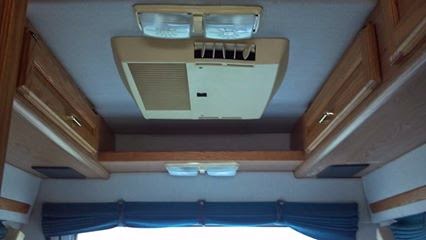
To me, the air conditioner is one of the nice things about this arrangement. At the end of a long day, I know I can sleep where it is cool. I find that comforting.
I hope this gives you the basic idea of what my mother's home away from home was like. What questions do you have?
I can be reached at Wildman.charles@gmail.com or at 937-462-7082 by txt or voicemail.
Thanks for your interest.
![]() |
| 1994 Dodge Pleasureway with 112,000 miles |
If ever there was a vehicle that was only driven "By a little old lady", this is it. There are a couple scuff marks on the right side to prove it. Using your mirrors gets harder at some point in your life.
Mom traveled at a slow pace. Moving from place to place as she felt inclined. She met many people and saw those things that interested her along the way.
![]() |
| You can see a lot through a windshield |
![]() |
| both seats will reverse for seating |
This home away from home provided a kitchen with conveniences. Microwave, refrigerator (this is a standard dorm refrigerator since the gas convertible one died), sink, propane cooktop, hot water, and various storage options, all came with the deal.
The rear area was for sleeping and dining. The table and desk box can lay down between the benches to form a base for the back rests to lay on, making a queen size sleeping area.
The RV is equipped with propane hot water, propane furnace, a refrigerator (originally an electric/propane refrigerator), sewer and holding tanks, fresh water both from a hook up or internal tank, and a cable TV access point.
![]() |
| controls for generator, water pump, holding tanks, co/smoke detector |
![]() |
| furnace vent |
![]() |
| storage for electric cord |
![]() |
| 30 amp 120 volt |
![]() |
| propane tank |
![]() |
| Not sure why fresh water hook up and sewer hose storage are side by side |
The bathroom and shower are the same physical space and would seem sort of tight. Not the high point of the tour but handy at certain times.
To me, the air conditioner is one of the nice things about this arrangement. At the end of a long day, I know I can sleep where it is cool. I find that comforting.
I hope this gives you the basic idea of what my mother's home away from home was like. What questions do you have?
I can be reached at Wildman.charles@gmail.com or at 937-462-7082 by txt or voicemail.
Thanks for your interest.
Saturday, May 17, 2014
Get in the Basement, NOW!
The farmer's I know are a tough and resilient lot, not given to lengthy speeches, so when they utter a command like, "Get in the basement, NOW!" it is the wise person that obeys. My neighbor's family undoubtedly heard something similar the other afternoon, all obeyed, and all were survived a direct hit from a tornado.
This is the scene two days later when I arrived to help in the clean up. I was dumbfounded by the destruction and the intense activity involved in the cleanup. It touches my emotions to see a community marshal so many resources in such a short period of time to help a neighbor in need.
I don't know who, but it was obvious that someone that knew how to organize people was leading the cleanup effort.
I observed no sign of law enforcement to maintain order. No one obviously directing traffic. No one driving by to watch. No one (except me) taking pictures. Just a beehive of people doing stuff. If anyone were to be caught looting they are to be pitied among men.
I noticed that everything a man had built over a lifetime was gone, but the land that has sustained him remains. How fleeting is the work of our hands.
As I spoke with the two farmer's that call this sight "home", two generations working together, I was struck by their gentle, humble, and peaceful recognition that life goes on.
The verse in Ecclesiastes 3 comes to mind "There is a time for everything, and a season for every activity under heaven: a time to be born and a time to die, a time to plant and a time to uproot,......I know that there is nothing better for men than to be happy and do good while they live. That every man may eat and drink, an find satisfaction in all his toil-this is the gift of God. .....".
There is also the story of how Job responded to the devastation that befell his family and property, a wealthy man wiped out in a single day, Job 1:20 "...Then he fell to the ground in worship and said, "Naked I came from my mother's womb and naked I will depart. The Lord gave and the Lord has taken away; may the name of the Lord be praised."
These are not men to preach scripture to you, or lecture it in the streets, but they communicated their deep faith and understanding of life simply in their living and fortitude. The crowd that showed up in their time of need is testimony to how clearly they have lived among their neighbors. This is the stuff that makes a farm community and makes me proud to be a part of it.
On behalf of the families struck by this disaster I want to say "Thank you!" to the community that showed up helped and cared. It is this acting together that makes a person feel safe, secure, and at home. Thank you to everyone.
![]() |
| the scene two days later |
I don't know who, but it was obvious that someone that knew how to organize people was leading the cleanup effort.
![]() |
| A food tent was established |
![]() |
| A parking area was cleaned and established |
![]() |
| Heavy equipment and many hands were hard at it |
![]() |
| This was a farmstead two days ago |
![]() |
| 71 years it took to build |
![]() |
| One moment to destroy |
![]() |
| Skill and training are needed to remove grain from damaged structures safely |
![]() |
| shinny grain bins are part of a farms beauty and pride |
![]() |
| a year's worth of work is stored inside |
![]() |
| This is not how you are suppose to move a "wet holding" bin |
![]() |
| Trucks, power, cranes, driveways, it all came together |
![]() |
| Wonder how that got there? |
The verse in Ecclesiastes 3 comes to mind "There is a time for everything, and a season for every activity under heaven: a time to be born and a time to die, a time to plant and a time to uproot,......I know that there is nothing better for men than to be happy and do good while they live. That every man may eat and drink, an find satisfaction in all his toil-this is the gift of God. .....".
There is also the story of how Job responded to the devastation that befell his family and property, a wealthy man wiped out in a single day, Job 1:20 "...Then he fell to the ground in worship and said, "Naked I came from my mother's womb and naked I will depart. The Lord gave and the Lord has taken away; may the name of the Lord be praised."
These are not men to preach scripture to you, or lecture it in the streets, but they communicated their deep faith and understanding of life simply in their living and fortitude. The crowd that showed up in their time of need is testimony to how clearly they have lived among their neighbors. This is the stuff that makes a farm community and makes me proud to be a part of it.
On behalf of the families struck by this disaster I want to say "Thank you!" to the community that showed up helped and cared. It is this acting together that makes a person feel safe, secure, and at home. Thank you to everyone.
Tuesday, May 13, 2014
Quick notes from Animal Ag Alliance Stakeholder Summit
Cracking the Millennial Code:
The Animal Ag Alliance hosted its annual conference in DC
last week. Click for more information.
Honesty drives me to point out that the only part of the code I was interested in cracking is “how do we get money out of
their pockets?” If not for that issue there would have been no conference,
unless it was the secondary “How do we get them to vote for us?” or "How do I communicate affectively with this group?"
A quick glance at the list of speakers will show you that there were a lot of experienced and talented people presenting their ideas. I had to work hard to keep up. Let alone understand the importance of what I was hearing. For a taste of what the conference was like here is a link to a session from Panera Bread
The take home points for me were something like this and amount to little more than quick notes and personal thoughts:
Millennials are hard to define.
Millennials are an extension of the “me” generation in that
they “want it now, the way they want it, with good quality, and a low price”.
Which makes you pause and think when you realize how many choices there are for
entertainment, news, information, social groups, and so forth, all the way down
to personalized coupons at the checkout register. My thought was, "And our government is trying to
give us a “one size fits all” health care system and tax code. Politics aside,
can that possibly have any staying power in our society?" I want to be treated as an individual, not a group.
Millennials were defined by age but the working definition
at the conference seemed to be, "those people that are living highly connected, social
media lives."
Millenials shy away from long term relationships/commitments
(from marriage to phone contracts) since they have seen and been hurt by so
many in the past.
Millennials want transparency as a substitute for honesty
and trust. Their life experience has taught them not to trust anyone because no
one is honest. Broken homes. Broken marriages. Government lies. Depravity in
the church. Schools that don’t teach but indoctrinate. Scientific manipulations.
A press full of propaganda and not news. Etc.
So if they don’t see it themselves or at least get it from a friend,
they doubt it. They are skeptics first. It is a really sad commentary on the
failures of society’s institutions. All of them.
Millennials want a company to be about more than “making
money”. They are highly sensitive to the ability for a company to make money by
ignoring the environmental costs of their endeavor (exploiting the environment)
or exploiting workers, so they want to know the company has that cost built
into its equation somehow. This can be through environmental reclaimation
(planting trees comes to mind) or proving they don’t pollute (green companies)
in the first place to auditing of worker conditions in developing countries.
If a company is profitable, Millennials will expect it to be
socially conscientious with those profits and give back/pay it forward to
society in some public way. This is tough for those of us who think of charity
and good works as a private matter. My thought is that one should not do your
good works out in the public eye to be praised by man but should do them so
your heavenly Father alone is aware of them. Millenials aren’t trusting, and
secrecy is not part of their value system, so deeds done in secret/private
don’t get a company anything. So start a fund, start a campaign, stand for
something, start a hashtag, change your profile picture.
The crisis management exercise pointed out that companies
are being judged constantly by the mob that is millenials. The contrast between
what the communications department knew needed to be done to protect the
company’s image/brand/value (communicate and be transparent) to fend off the
judgment of the millennial mob and what the legal department wanted to do to
protect the company from the trial by jury that was obviously coming, could not
have been clearer. One says “if you don’t tell your story someone else will”,
the other says “anything you say, can and will be used against you in a court
of law” so stop communicating/talking.
Sustainability fits in here somehow.
They are cynics until you question/challenge their reality
then you are evil and must be destroyed. Perception is reality to them and
reality is not welcome.
The conference had too much information for me to assemble
and process at one time into much more than the notes listed above. I hope that
others who were there or watching on line may comment and post links that
expand these thoughts. As a pig farmer, my mind struggled to follow some of
these very good and well educated and trained speakers. I am trained to observe
animals with my eyes, ears, and nose more than to listen and ponder big ideas,
but exercise builds strength, so I appreciate the experience and exposure to
the new ideas.
Sunday, April 6, 2014
The Wall Street Journal, Dried Blood Plasma, Pig Feed, and PEDV
I write this post as a result of a online conversation. A conversation that was kicked off by this article that appeared in the Wall Street Journal which looks at the possible role feed may play in the spread of a new disease in the US swine heard. As a producer, it seems like a pretty reasonable article on the current situation in the pig business related to a virus known as PED-V. Several questions coming out of that discussion were basically, "So what is in pig feed?" "How would I know?" And of course, "Should I be concerned?"
These all seemed like pretty sensible questions that I, a pig farmer, should be able to answer. I now realize that I know answers to some of these questions or maybe I should say I know some of the answer to all these questions. As I conversed, I came to understand that some part of these answers just gets a bit too academic for me. So let me share the part I do know.
Pig feed, in my commercial setting (I will see about 25,000 pigs this year), is made from three main things. Corn, soybean meal, and a product called a "premix". These three ingredients are blended together in various proportions to make numerous "rations" or "phases". Each "ration" and "premix" is professionally formulated by a nutritionist to meet the pigs dietary needs for a particular "phase" in the pigs life. When I need feed I call a feed supplier (a feed milling company) and they use these formulations to prepare the requested feed, then they deliver it to my farm. Here is a video of feeding newly weaned pigs. Feeding newly weaned pigs.
Think about your children as they grow. They grow through various growth "phases" and you as a good parent attempt to adjust their meals "rations" to recognize the changing dietary needs your children have. Your baby gets breast milk or formula. Then there is a transition time (which can be challenging for everyone) to solid food. The contents of that solid food change as the quantity being consumed increases. You notice your child having growth spurts where they seem to eat everything in the house, then they slow down. In the teen years, at least for my boys, they ate constantly. So mom adjusted what was in the house to be eaten. And so on it goes on through life.
This is the big picture of what is being done with the three ingredients in pig feed. Now to the online conversation and the Wall Street Journal article.
So how does this work?
Here is the process.
I have pigs that need feed.
In my case I buy young pigs that have just been weaned from their birth mother's at the Fair Oaks Pig Adventure. They are about 21-24 days of age and weigh 12-18 #. They arrive on a semi truck to my barns after a 4 hour ride. Here is a 5 minute video my daughter made of how we wean baby pigs.
I call the feed milling company and tell them what "phase/ration" is needed and how many tons I want. They mill and deliver the request then send me a bill.
Feed arrives on my farm from the feed mill in a semi truck and is put in these bins. Each delivery comes with paperwork that is placed in the mailbox. This paperwork allows me to know what is in the bins. Which ration. Which bin. What is in the ration. What day. Where it was mixed. And many other things. The paperwork allows for trace back should some question arise at a later date about what the pigs where feed etc.
The paperwork that comes with a load of pig feed looks like this. There are three pieces of paper. The center white one identifies the ingredients in the ration. The yellow one on the left is the "pick ticket" which tells the driver which rations are in which compartment of the trailer and where they go when they arrive on my farm. The yellow sheet on the right is the scale receipt that ultimately generates my bill. Maybe I ordered 24 tons of feed but the system actually manufactured 48,230# of feed. Life is that way. I get billed for 48230# of feed.
For this discussion it is the white paper that details the ingredients in a particular ration that is of interest. Below is the label for the first ration my newly weaned pigs will receive. They will eat this feed for 3-4 days and will each get about 2# of it.
This particular ration is named "Prestart 12/15 Pellet MX" which means this is a feed to be used as feed in advance (pre) of starting the pigs on ground feed and it is designed for pigs weighing from 12-15 pounds. It is a pellet type feed, as opposed to a ground meal or mash, and that it is medicated (MX).
All of this is explained in greater detail in the fine print. I describe the medication side of this in this blog about medications in pig feed.
Note: some of this gets down to PPM = parts per million
The next picture shows the bottom of the same tag where the ingredients are listed. This is where my education starts to fall short and I am depending on the professional swine nutritionist and the research community to formulate a proper feed. The nutritionist is using all the research he can find (much of it from the land grant colleges of the US), his experience, and his knowledge of the laws and regulations from FDA and others to put this formula together. I don't know particularly, what all these things are but you can see that Animal Protein Products, Animal Plasma, and Animal Fat are all listed. This is the product that the Wall Street Journal article was discussing. Here is a link to a paper that describes the Plasma Product in greater detail in layman's language. Please read it at least far enough to realize that the Plasma is reducing the need for antibiotics by boosting immune systems and increasing feed intakes (reducing dietary stress).
"The globulin proteins are commonly called “immunoglobulins”, and they are responsible for enhancing immunity in the recipient animal."
Having an "enhanced immunity" would mean reducing antibiotic usage, and that seems like a good use of the product.
The next tag is for the second ration the pigs will be fed. This will be their first ground (not a pellet or mash) feed. It is corn, soybean meal, and a premix. It is the last antibiotic these pigs will see before slaughter in 5 months unless there is some specific disease outbreak. Again I refer you to my blog post on medications in pig feed.
From my online conversation, I am aware that these ingredient lists can be seen as quite scary and some are quite opposed to parts of this. I would remind you that there is absolutely no reason a company or myself would be putting anything in a feed that we thought might harm the pigs or the consumer that is eventually going to put that pork on their dinner table. That would be shooting ourselves in the foot. I will close with this humorous clip by Penn and Teller and a discussion of Dihydrogen Monoxide.
I am very grateful for the really smart people in agriculture that work tirelessly to come up with innovative ways to put food on our plates that is safe, wholesome, and as environmentally friendly as possible.
These all seemed like pretty sensible questions that I, a pig farmer, should be able to answer. I now realize that I know answers to some of these questions or maybe I should say I know some of the answer to all these questions. As I conversed, I came to understand that some part of these answers just gets a bit too academic for me. So let me share the part I do know.
Pig feed, in my commercial setting (I will see about 25,000 pigs this year), is made from three main things. Corn, soybean meal, and a product called a "premix". These three ingredients are blended together in various proportions to make numerous "rations" or "phases". Each "ration" and "premix" is professionally formulated by a nutritionist to meet the pigs dietary needs for a particular "phase" in the pigs life. When I need feed I call a feed supplier (a feed milling company) and they use these formulations to prepare the requested feed, then they deliver it to my farm. Here is a video of feeding newly weaned pigs. Feeding newly weaned pigs.
| pigs are 21-24 days of age when weaned |
Think about your children as they grow. They grow through various growth "phases" and you as a good parent attempt to adjust their meals "rations" to recognize the changing dietary needs your children have. Your baby gets breast milk or formula. Then there is a transition time (which can be challenging for everyone) to solid food. The contents of that solid food change as the quantity being consumed increases. You notice your child having growth spurts where they seem to eat everything in the house, then they slow down. In the teen years, at least for my boys, they ate constantly. So mom adjusted what was in the house to be eaten. And so on it goes on through life.
This is the big picture of what is being done with the three ingredients in pig feed. Now to the online conversation and the Wall Street Journal article.
So how does this work?
Here is the process.
I have pigs that need feed.
In my case I buy young pigs that have just been weaned from their birth mother's at the Fair Oaks Pig Adventure. They are about 21-24 days of age and weigh 12-18 #. They arrive on a semi truck to my barns after a 4 hour ride. Here is a 5 minute video my daughter made of how we wean baby pigs.
I call the feed milling company and tell them what "phase/ration" is needed and how many tons I want. They mill and deliver the request then send me a bill.
Feed arrives on my farm from the feed mill in a semi truck and is put in these bins. Each delivery comes with paperwork that is placed in the mailbox. This paperwork allows me to know what is in the bins. Which ration. Which bin. What is in the ration. What day. Where it was mixed. And many other things. The paperwork allows for trace back should some question arise at a later date about what the pigs where feed etc.
![]() |
| Bins for pig feed/mailbox for paperwork |
The paperwork that comes with a load of pig feed looks like this. There are three pieces of paper. The center white one identifies the ingredients in the ration. The yellow one on the left is the "pick ticket" which tells the driver which rations are in which compartment of the trailer and where they go when they arrive on my farm. The yellow sheet on the right is the scale receipt that ultimately generates my bill. Maybe I ordered 24 tons of feed but the system actually manufactured 48,230# of feed. Life is that way. I get billed for 48230# of feed.
![]() |
| Standard paperwork with a load of pig feed |
For this discussion it is the white paper that details the ingredients in a particular ration that is of interest. Below is the label for the first ration my newly weaned pigs will receive. They will eat this feed for 3-4 days and will each get about 2# of it.
This particular ration is named "Prestart 12/15 Pellet MX" which means this is a feed to be used as feed in advance (pre) of starting the pigs on ground feed and it is designed for pigs weighing from 12-15 pounds. It is a pellet type feed, as opposed to a ground meal or mash, and that it is medicated (MX).
All of this is explained in greater detail in the fine print. I describe the medication side of this in this blog about medications in pig feed.
Note: some of this gets down to PPM = parts per million
![]() |
| this tag states clearly what is in the feed my pigs are eating |
The next picture shows the bottom of the same tag where the ingredients are listed. This is where my education starts to fall short and I am depending on the professional swine nutritionist and the research community to formulate a proper feed. The nutritionist is using all the research he can find (much of it from the land grant colleges of the US), his experience, and his knowledge of the laws and regulations from FDA and others to put this formula together. I don't know particularly, what all these things are but you can see that Animal Protein Products, Animal Plasma, and Animal Fat are all listed. This is the product that the Wall Street Journal article was discussing. Here is a link to a paper that describes the Plasma Product in greater detail in layman's language. Please read it at least far enough to realize that the Plasma is reducing the need for antibiotics by boosting immune systems and increasing feed intakes (reducing dietary stress).
"The globulin proteins are commonly called “immunoglobulins”, and they are responsible for enhancing immunity in the recipient animal."
Having an "enhanced immunity" would mean reducing antibiotic usage, and that seems like a good use of the product.
![]() |
| Ingredient list and feeding instructions |
The next tag is for the second ration the pigs will be fed. This will be their first ground (not a pellet or mash) feed. It is corn, soybean meal, and a premix. It is the last antibiotic these pigs will see before slaughter in 5 months unless there is some specific disease outbreak. Again I refer you to my blog post on medications in pig feed.
![]() |
| feed tag for ground feed ration |
I am very grateful for the really smart people in agriculture that work tirelessly to come up with innovative ways to put food on our plates that is safe, wholesome, and as environmentally friendly as possible.
Subscribe to:
Comments (Atom)